

Australia is feeling uneasy about immigration. This is not new.
But we are a migrant nation. So why are the political/media class drumming up anti-migrant fear? And why is it resonating so quickly and deeply that every political issue is suddenly only approachable through its lens?
I say again: this is not new. It is an easy task to trace this country’s anxiety over immigration through the laws we have made to manage it. What it reveals is that we are close to coming full circle.
First, a critical definition: when we say “immigration”, that isn’t what we mean. What we mean — have always meant — is non-white immigration. However, what we mean by “white” has changed.
Australia’s immigration debate is and always has been a racist one. It’s not, to be clear, about the numbers, much as we pretend otherwise.
Related Article Block Placeholder
Article ID: 1260195
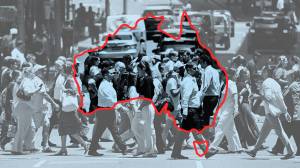
In the constitutional debates leading up to Federation in 1901, much focus was given to racial questions, specifically what colour Australia was going to be. Very little time was spent discussing the Indigenous population, which it was openly assumed would conveniently complete its task of dying out.
No, the problem occupying policymakers was Australia’s location and the Yellow Peril. Thus, the constitution included explicitly racist provisions, empowering the new federal government to make special laws for races.
One of the government’s first orders of business was, accordingly, to make laws creating the White Australia Policy. The Immigration Restriction Act was passed, implementing the notorious rule that any immigrant could be excluded if they failed to pass a dictation test of 50 words in “any European language” at the direction of a customs officer.
Why were we so coy? The prime minister, Edmund Barton, explained the government’s “determination to prevent the influx of these hundreds of millions of Asiatics, alien in religion and alien in customs”; however, at the same time, “to exclude, by reason of their colour or race, all Her Majesty’s Indian subjects, or even all Asiatics, would be an act so offensive to those peoples that it would be most painful to Her Majesty to have to sanction it”.
As the parliamentary debate on the first immigration law in 1901 makes very clear, everyone knew the object: keep non-whites out. But, given that the empire’s embrace encompassed a population that was maybe 15% “British”, a conceit was required to foreclose any suggestion that the reason for this desire was somehow racist.
As a government minister in the UK had said when dealing with an earlier immigration law in the British colony of Natal that had similarly been designed to keep coloured races (mainly, “Hindoos” as they were referred to) out, the law was seen as a favourable precedent in Australia: “It is not because a man is of a different colour from ourselves that he is necessarily an undesirable immigrant, but it is because he is dirty, or he is immoral…”
Related Article Block Placeholder
Article ID: 1266097

If you’re not picking up the golden thread through to the present-day immigration policy rationale of One Nation, you’re not concentrating.
The White Australia policy remained in place until the late 1960s, finally buried by the Whitlam government in 1972. It had been used to keep out almost all but British migrants until the post-World War II period, when the definition of whiteness was effectively expanded to include Southern Europeans (particularly Greeks and Italians) and Jews. “Asiatics”, and everyone else who we would now describe as “persons of colour”, remained excluded.
The law had kept pace; the original, brutally simplistic, immigration laws were replaced in 1958 by a more detailed Migration Act which remains the basis for the incredibly complex legislation in force today. As borders became more permeable and human traffic expanded, powers were constantly created and expanded to maintain Australia as white.
There was then a single phase, unique in our history, during which the colour bar was removed and immigration became a facilitative rather than defensive construct. It was the period of the Whitlam, Fraser and Hawke-Keating governments, which saw large inflows of refugees and the first waves of Asian immigration. Compassion, openness and multiculturalism were, briefly, in vogue, and anxiety in recess.
And then came John Howard. It’s interesting to hear him and his former ministers talk these days of their concerns that the immigration debate is turning nasty and tinged by racism; I think they genuinely don’t recognise how much their own meanness of spirit influenced the country’s mindset around the subject of who, as Howard famously put it, comes here and the circumstances under which they arrive.
In any event, law quickly followed the shift in sentiment. Laws created the Pacific Solution, offshore detention and onshore prisons, and temporary bridging visas. Immigration became border protection. Migrants became a threat.
If the high point of racial neutrality was reached somewhere in the early 1980s, there has been a widening gap between the reality of migration patterns and public anxiety around it ever since. The policy remains neutral and the inflow beautifully diverse. Attitudes, however, are hardening.
Related Article Block Placeholder
Article ID: 1265113

Enter Pauline Hanson, who’s been playing the race card since 1996. Her time to shine. The major parties are following in a panic, knowing that you can’t win an argument against existential racist dread in this country.
A One Nation government definitely would, a Coalition government almost certainly would and a Labor government highly likely will, look to fresh legal measures to reflect the now-entrenched demand that something be done to stem the flow.
As Hanson has always said, she doesn’t care whether you’re “black, white or brindle”. It isn’t migrants’ colour she objects to, but their incompatibility with our monoculture.
Racism has always been masked with weasel words about assimilation, as much in 2026 as it was in 1901.
Full circle.
